Three days after Hiroshima, the U.S. B-29 Bockscar left Tinian carrying Fat Man, a plutonium bomb. Kokura was the primary target. Obscured visibility prevented a drop there, and the crew turned to Nagasaki, the secondary target.
- Morning
Kokura to Nagasaki
The aircraft made multiple approaches over Kokura before leaving for Nagasaki. The change in course exposed an entirely different city to the bomb.
- 11:02 a.m.
Airburst above the Urakami Valley
The bomb detonated about 500 meters above the Matsuyama area. Heat, blast and radiation struck the neighborhoods below. The hills shaped the distribution of blast damage across the city.
- Hours later
Rescue amid destroyed streets
People searched for relatives and water as surviving medical staff attempted to treat burns and other injuries. Dr. Takashi Nagai and colleagues organized relief despite their own injuries and losses.
- By December
About 74,000 deaths
A postwar survey cited by the city estimated 73,884 deaths and 74,909 injuries by the end of December. The precise-looking numbers come from a retrospective estimate.
- City of Nagasaki · Record of the atomic bombing
- U.S. National Park Service · Timeline of both missions
- Visit Nagasaki · Hypocenter Park and cathedral relic
- City of Nagasaki · Damage caused by the bombing
- Nagasaki Atomic Bomb Museum · Dr. Takashi Nagai
The Soviet Union declared war on Japan on August 8. Japan announced its surrender on August 15 and formally signed on September 2. Read the Nagasaki mission alongside those events to see how closely they followed one another.
National Diet Library of Japan · Historical chronology
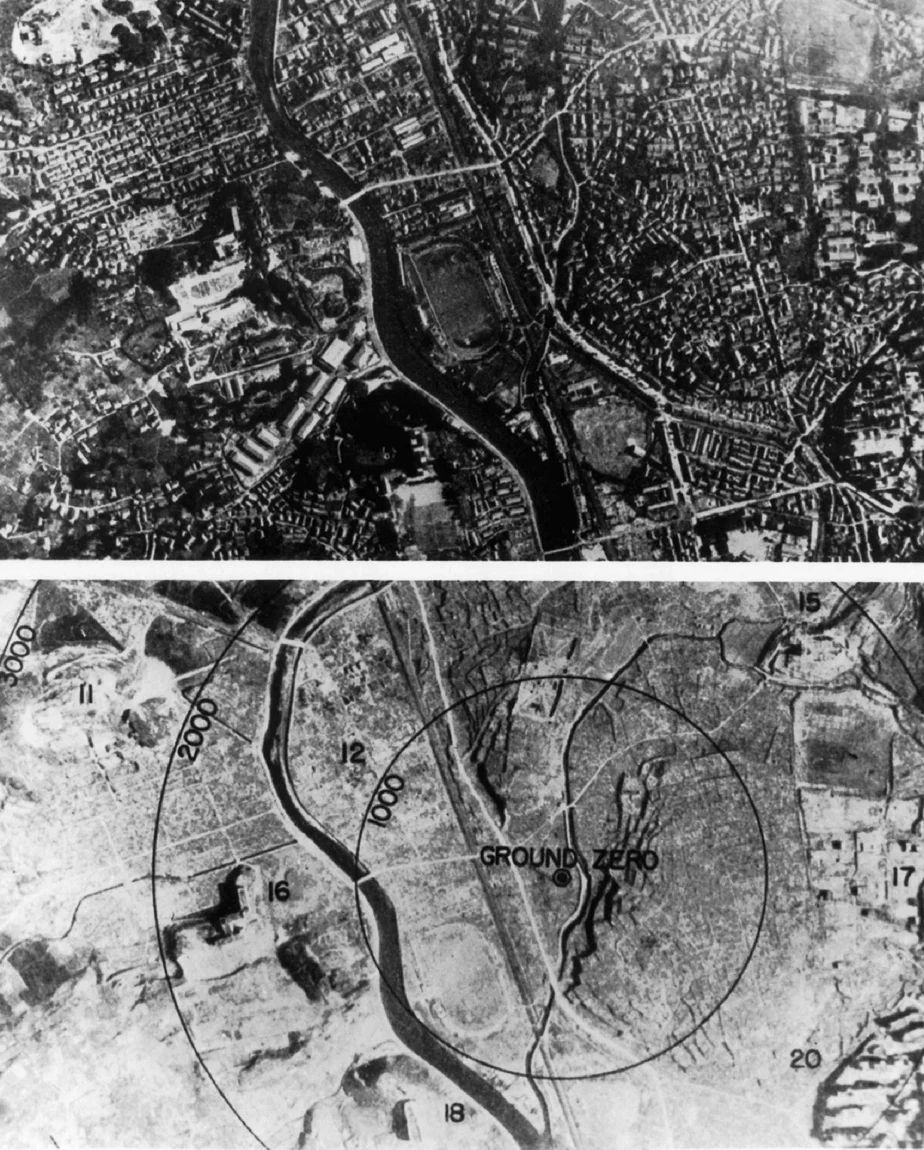

A change of destination, then an airburst over a valley
The August 8 field order named Kokura first and Nagasaki second. Read the mission chronology against the city archive. The flight record follows a crew making decisions as visibility and time changed. The city record follows what happened below when the crew reached Nagasaki.
The hills around Urakami affected how damage spread. Compare the paired U.S. reconnaissance photographs and follow the valley rather than assuming the destruction extended evenly in a circle. The city’s damage archive separates heat, fire, blast and radiation into different collections.
A household clock near Sannō Shrine, about 800 meters from the hypocenter, stopped at 11:02. The museum uses that object to open its account of August 9. It records the airburst from within a home.