A friendship with a history
Before the two countries fought a war, people on both sides of the Pacific were already building relationships. In 1912, Tokyo sent Washington cherry trees. Helen Taft and Viscountess Chinda planted the first two by the Tidal Basin. The trees gave that relationship a living presence in the American capital.
The war brought the attack on Pearl Harbor, years of fighting across Asia and the Pacific, and American atomic attacks on the inhabited cities of Hiroshima and Nagasaki. Japanese Americans, including U.S. citizens, were forcibly removed and incarcerated by their own government. These histories have different causes and consequences. Each belongs in an honest account of how the two countries came to meet again.
From formal peace to cooperation
The Treaty of Peace with Japan was signed at San Francisco in 1951 and entered into force in 1952. The 1960 Treaty of Mutual Cooperation and Security became a foundation of the bilateral alliance. Diplomatic agreements changed the relationship between governments. The work of rebuilding trust also took place among survivors, families, educators and civic institutions.
In 1988, the United States enacted the Civil Liberties Act, formally acknowledging the injustice of wartime incarceration and authorizing redress. After the March 2011 earthquake and tsunami in Japan, Japanese and American teams cooperated on humanitarian relief under Operation Tomodachi. These events show two kinds of work a lasting relationship can require: taking responsibility and showing up for one another.
Hiroshima · May 27, 2016
Barack Obama became the first sitting U.S. president to visit Hiroshima. At Peace Memorial Park, he and Prime Minister Shinzo Abe laid wreaths and spoke in the city that had endured the first atomic attack. Obama met survivors, bringing people who carried that history into the encounter between the two governments.
Read the two leaders’ remarks side by side. Obama spoke about the moral responsibility that accompanies scientific power. Abe spoke about those who died as people with families and hopes, and about what the visit meant for trust and friendship.
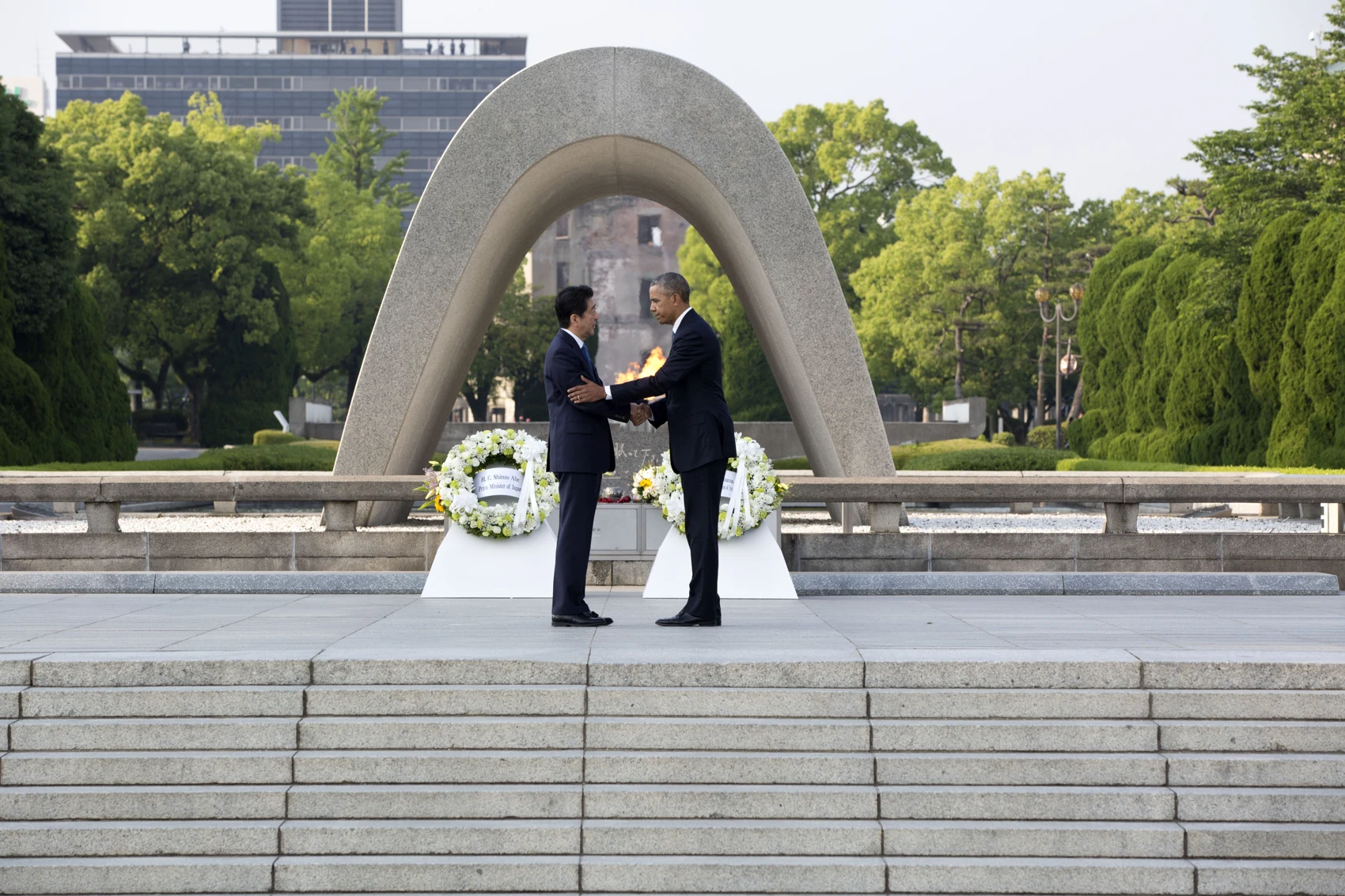

Watch the White House record of the Hiroshima visit
Pearl Harbor · December 27, 2016
Seven months later, Abe and Obama visited the USS Arizona Memorial in Hawaii. They honored those killed in the Pearl Harbor attack, and Abe spoke about reconciliation between former enemies. Reading the two visits together shows how each leader entered a place sacred to people in the other country.
Hiroshima, Nagasaki and Pearl Harbor have their own histories and communities of mourning. A shared memorial practice can make room for each without treating their experiences as interchangeable.
Watch the White House record of the Pearl Harbor visit
Japanese traditions of remembrance
The site’s open ink-circle detail takes inspiration from the ensō (円相), a circle brushed in ink in the Zen tradition. Its use here is a visual gesture toward reflection in a civic memorial for visitors of every belief.
Asian Art Museum · An ensō in the collection
In Hiroshima, the Peace Bell and a minute of silence mark 8:15 a.m. on August 6. At the Children’s Peace Monument, folded cranes connect a familiar Japanese craft with the memory of Sadako Sasaki and other children. In the evening, paper lanterns drift down the Motoyasu River carrying messages of peace.
Nagasaki holds its own ceremony on August 9. At its National Peace Memorial Hall, water recalls the thirst of people who died after the bombing. Each city has its own places and practices. A memorial in Washington can draw on these histories by explaining where each gesture comes from and working with Japanese partners on how to carry it out.
Folded cranes
The cranes at Hiroshima’s Children’s Peace Monument recall Sadako Sasaki and the effort by her classmates to remember children killed by the bombing.
Hiroshima’s cranes →Lanterns on the Motoyasu
On the evening of August 6, people float paper lanterns carrying peace messages on Hiroshima’s Motoyasu River.
The lantern ceremony →Water for remembrance
At Nagasaki’s National Peace Memorial Hall, the water basin recalls the thirst of those who died. That documented practice gives the proposed Washington reflecting pool another association.
Nagasaki’s remembrance sites →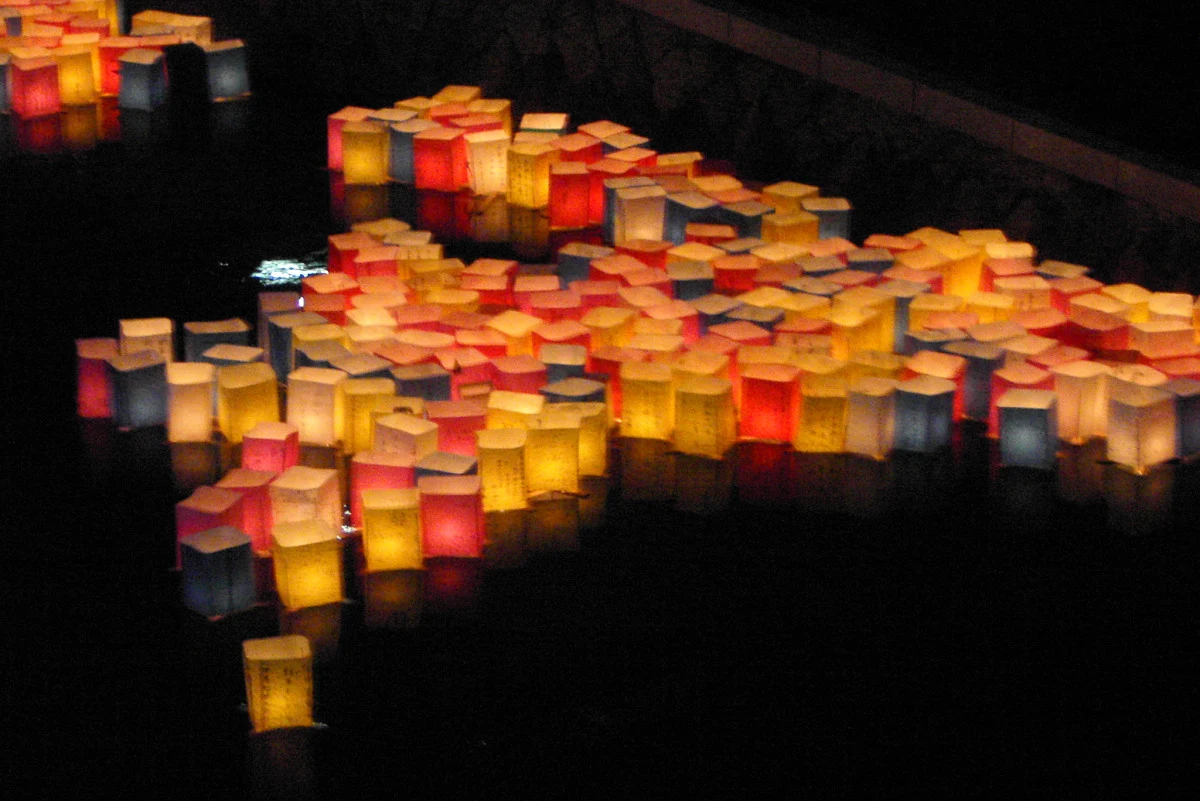

What survivors ask of the future
At the 2023 Hiroshima summit, G7 leaders issued a statement on nuclear disarmament. The next year, Nihon Hidankyo received the Nobel Peace Prize for survivor-led efforts toward a world without nuclear weapons. These are different kinds of work. One is an agreement among governments. The other grew out of the determination of people who survived to tell the world what happened in their cities.
Listen to Terumi Tanaka’s Nobel lecture alongside the Hiroshima and Nagasaki testimonies. The survivors brought the consequences of the bombings into discussions that can otherwise stay at the level of weapons, strategy and diplomacy.
What Washington could hold
A memorial in the American capital could begin by naming what the United States did and whose lives were lost. Bilingual inscriptions could be developed with survivors, families and Japanese cultural partners. The grove would recall the 1912 gift. The still water would give visitors time to reflect and could carry an explanation of its meaning in Nagasaki.
On August 6 and 9, a Washington observance could read the two city names and the local times of the bombings in Japanese and English. A moment of silence and a survivor’s recorded words could follow. Schools and community groups could learn the story of Sadako and the Children’s Peace Monument before folding cranes. The city archives give visitors a way to continue listening after they leave.